
The challenge was to integrate hydrogen into everyday mobility services and demonstrate its value to citizens under real operating conditions. A hydrogen bus was considered first, but light-duty mobility was chosen for its higher demand, easier integration with FHA’s existing refuelling infrastructure, and the chance to strengthen operations while delivering a practical service to users.
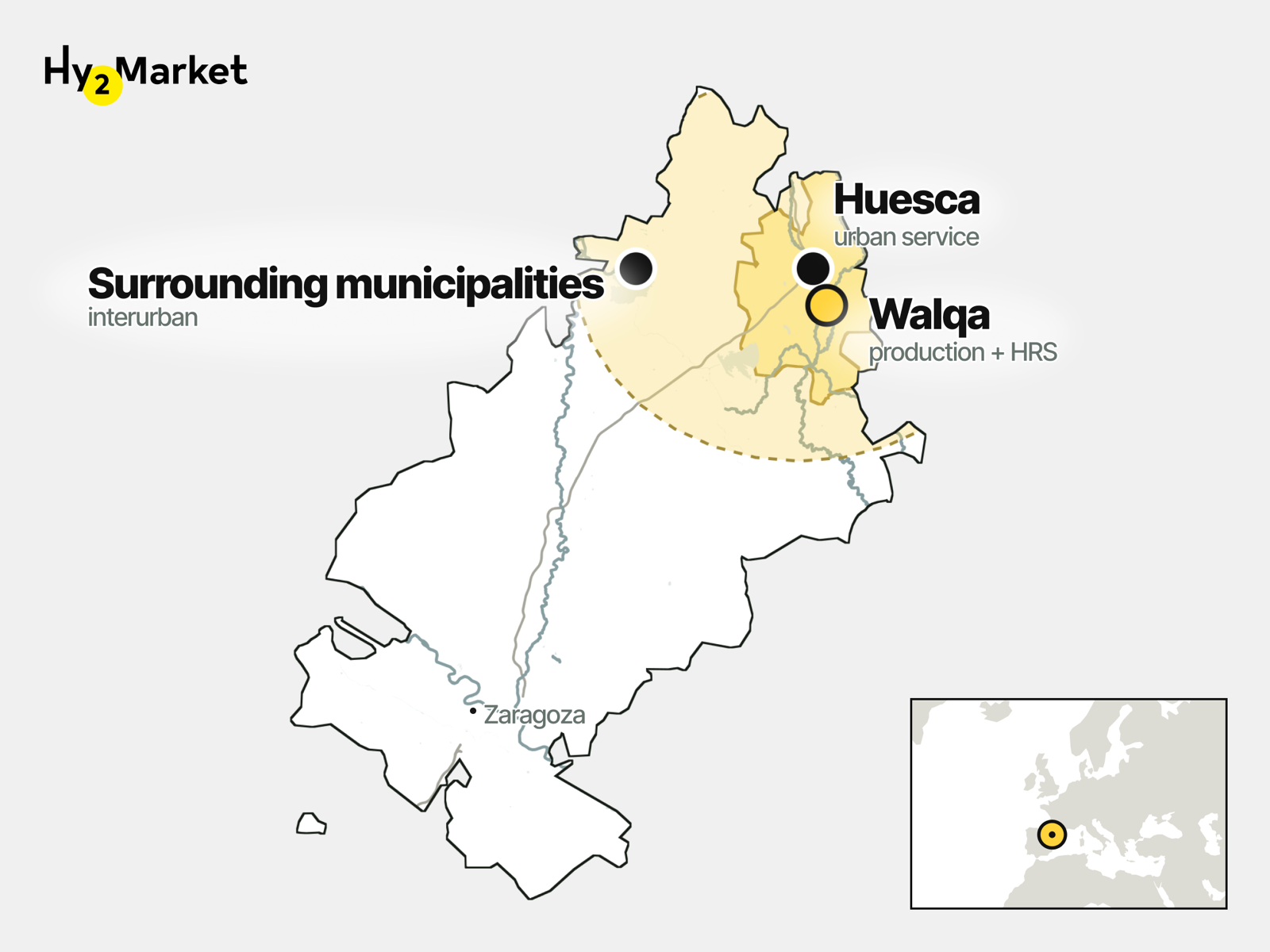
The pilot uses hydrogen-powered taxis to bring the technology closer to citizens. Taxis link Huesca with surrounding municipalities, serving residents, students and patients travelling to key services. Their mix of short urban trips and longer interurban journeys creates a demanding real-world use case — an ideal way to demonstrate hydrogen mobility.
The project lays the foundations for hydrogen-powered light mobility in Aragón through the region’s first public hydrogen taxi. Beyond the vehicle itself, it has brought together key stakeholders to open the door to wider adoption — a reference case that could inspire similar initiatives across Aragón and the rest of Spain.
Fundación Hidrógeno Aragón · Huesca — introducing Spain’s first public hydrogen taxi demonstration.
The region
Aragón is one of Spain’s leading hydrogen regions, combining a strong industrial base with a growing ecosystem of hydrogen production, research and refuelling infrastructure. While Zaragoza concentrates most of the population and economic activity, many smaller municipalities rely on regular connections with regional service centres such as Huesca, creating a constant demand for flexible mobility solutions.
Through its hydrogen strategy and the work of organisations such as Fundación Hidrógeno Aragón, the region has become a reference point for new hydrogen applications. As transport remains one of the hardest sectors to decarbonise, Aragón is using real-world mobility projects to explore how hydrogen can complement other zero-emission technologies in demanding day-to-day operations.
The opportunity
Aragón’s opportunity is to demonstrate hydrogen where flexibility and range matter most: in intensive taxi operations connecting Huesca with surrounding municipalities.
The pilot uses a hydrogen-powered taxi to test the technology in one of the most demanding light-mobility applications. Unlike many private vehicles, taxis operate for long hours, cover significant distances and must remain available throughout the day. In Huesca, they also provide important connections between the city and nearby municipalities — allowing hydrogen mobility to be demonstrated under real operating conditions while bringing the technology closer to citizens.
The solutions
From hydrogen production to everyday passenger transport — three moving parts make up the demonstration. Open each to see the detail.
How it works as one system
A complete hydrogen mobility chain, from green production to public service. Hover any node to highlight it, click to open the detail.
- Renewable hydrogen production
- FHA · solar + alkaline electrolyser
- Renewable hydrogen is produced at FHA’s facilities using solar electricity and an alkaline electrolyser. Producing the fuel on site allows the demonstration to connect renewable energy generation directly with transport applications.
- Hydrogen refuelling
- 700 bar HRS · Walqa Technology Park
- The hydrogen is supplied through FHA’s refuelling infrastructure in Walqa Technology Park. The station can dispense hydrogen at up to 700 bar, allowing vehicle refuelling in less than five minutes and supporting regular taxi operations.
- Toyota Mirai 2 — fuel-cell taxi
- Second-generation fuel-cell electric vehicle
- The demonstration vehicle is a second-generation Toyota Mirai adapted for professional taxi service. Its long driving range and rapid refuelling capability make it suitable for intensive daily operation.
- Public taxi service
- 3 months · ~15,000 km demonstration
- The hydrogen-powered taxi will operate as a regular public transport service for three months, covering an estimated 15,000 km. By combining urban and interurban journeys, the pilot will generate operational experience under real conditions while bringing hydrogen mobility directly to citizens.
- Urban mobility
- Huesca
- Daily trips within Huesca will demonstrate the suitability of hydrogen vehicles for frequent stop-and-go operation, a common requirement in taxi services.
- Regional connections
- Surrounding municipalities
- The taxi will also provide interurban services linking Huesca with nearby towns and villages, making use of the vehicle’s extended driving range and rapid refuelling capability.
- Future deployment
- Aragón & Spain
- As Aragón’s first public hydrogen taxi, the pilot creates a reference case for future hydrogen mobility initiatives and helps identify the conditions needed for wider adoption of fuel-cell vehicles. The taxi driver is already chosen and the vehicle is being adapted; the next steps are to complete the legalisation process, finalise the refuelling-station adaptations and officially launch the pilot.
- Public awareness
- Citizens
- Operating as a regular taxi service allows citizens to experience hydrogen mobility directly, increasing visibility and familiarity with this zero-emission transport technology — as well as with the hydrogen value chain and its value to their community.
- Knowledge exchange
- Hy2Market · WP5 mobility regions
- Operational data and lessons learned will be shared with other Hy2Market partners, contributing to a better understanding of hydrogen mobility applications across different regions.
The process
FHA begins exploring how hydrogen can be integrated into public mobility services in Aragón. The initial concept focuses on a hydrogen bus connecting Huesca and Walqa Technology Park.
The bus concept is reassessed after practical challenges with refuelling, site access for large vehicles and creating a new public route. FHA begins evaluating alternative mobility applications.
A hydrogen taxi demonstration is selected as the preferred approach. FHA brings together Huesca City Council, local taxi associations and Toyota Spain to develop the pilot.
Following an information session and selection process, the pilot taxi driver is chosen. The Toyota Mirai undergoes the final approval required to operate as a licensed taxi.
Hydrogen taxi operations are scheduled to begin — launching Aragón’s first public hydrogen taxi demonstration, with three months of real-world service planned until January 2027.
Lessons learned
Lessons learned will be documented once the demonstration has been completed.
The pilot is currently in its implementation phase. Operational experience, feedback from the taxi driver and users, and insights related to refuelling and day-to-day operation will be assessed after completion of the demonstration period.
The outcomes
Results will be published once the demonstration concludes and operational data has been evaluated.
Knowledge exchange
Aragón contributes to Hy2Market’s hydrogen mobility activities by exploring the use of hydrogen-powered taxis in real transport services — expanding the range of mobility applications tested across the project and providing operational experience other regions can draw on.
Aragón’s experience will provide insights into hydrogen applications beyond buses and fleet vehicles, helping partners assess the suitability of hydrogen taxis and other light-duty mobility solutions.
As the first public hydrogen taxi initiative in Aragón, the pilot can help public authorities, infrastructure operators and transport professionals better understand the practical requirements of hydrogen mobility deployment.
Lessons and operational data generated by the pilot will feed Hy2Market’s wider knowledge-sharing activities, supporting future projects, replication efforts and mobility planning across participating regions.