
Asturias is a coal-and-steel heartland that has to decarbonise without hollowing out the industry that built it. A standalone electrolyser risks producing hydrogen no one has committed to buy — and a coal plant like Aboño is the kind of asset a just transition usually retires rather than repurposes.
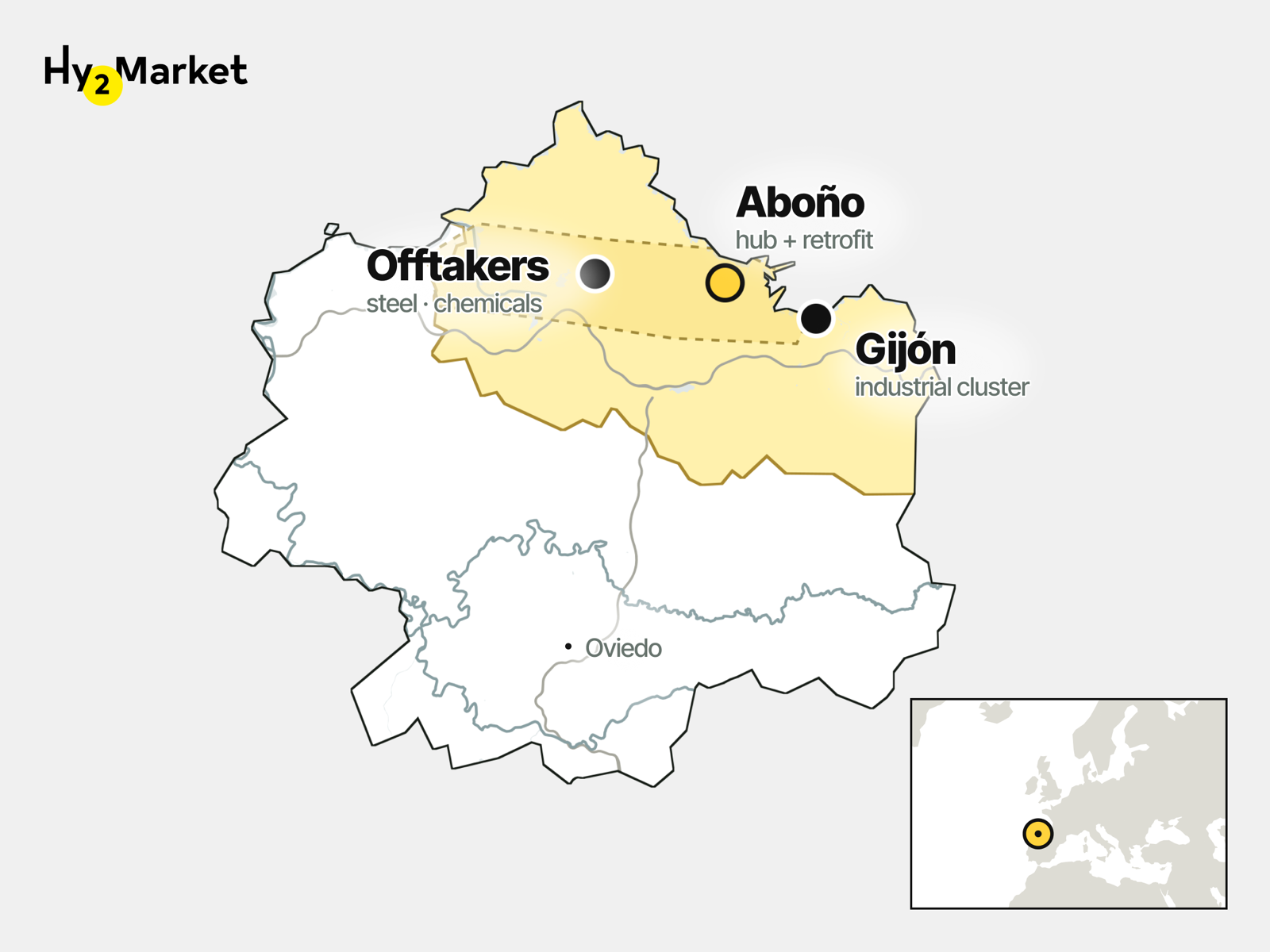
EDP is building the Asturias H2 Valley: a 150 MW green-hydrogen production hub next to the Aboño power plant near Gijón, sized from the start around real industrial offtake rather than production alone — and sitting beside a converted power-plant boiler that can take hydrogen in its fuel mix.
A full-stack production blueprint for coal regions in transition: an electrolyser, an anchor industrial consumer, and a feasibility path to scale from 150 MW toward 500 MW — with the permits already in hand and the build now going to tender.
Vanessa Hernández, EDP — on building the Asturias H2 Valley around the industry that will use its hydrogen.
The region
Asturias sits on Spain's northern coast — a compact, mountainous region that was for a century the country's coal-and-steel engine. Gijón and its surroundings still hold one of Spain's densest concentrations of heavy industry: steelmaking, refining, glass, zinc and chemicals, all clustered within a few kilometres of the same port and grid. That industry never left; what changed is that its fuel has to.
The Aboño thermal power plant, on the coast just outside Gijón, is emblematic of that shift. Built to burn coal, it is exactly the kind of asset a just transition has to reckon with — and exactly the kind of site EDP chose to build its hydrogen future on, rather than around. In July 2025 its Unit 2 came back online on natural gas, after all 30 coal burners were replaced with burners designed for natural gas and hydrogen. The region's advantage is that the customers, the infrastructure and the institutional will are already in the same place.
The opportunity
Asturias's advantage is that it is building production and demand as a matched pair — not standing up an electrolyser and hoping offtakers appear.
EDP sized the hub around industry that is already on the doorstep and already needs to decarbonise. As project director Rafael Cabañeros puts it, the region offered three things at once: a strong industry with real needs, mature energy infrastructure and security of supply, and a regional ecosystem — social, administrative and institutional — willing to support the project. Few places in Europe combine all three around a single site.
The solutions
Three moving parts make the hub work as one system. Open each to see the detail.
How it works as one system
From renewable power to industry and a retrofitted boiler. Hover any node to highlight it, click to open the detail.
- Renewable electricity
- EDP Renewables
- Renewable generation from EDP Renewables feeds the electrolyser, making the hydrogen genuinely green.
- 150 MW electrolyser
- Asturias H2 Valley · Aboño
- The first-phase 150 MW green-hydrogen plant beside the Aboño site, part-funded by the EU Innovation Fund, designed to produce ~20,000 t/yr and cut emissions by 99.98% versus displaced fossil fuels.
- Green hydrogen
- ~20,000 t/yr
- Roughly 20,000 tonnes of renewable hydrogen per year — the hub's output, sized around real industrial demand rather than production alone.
- Industrial offtake
- Cluster + Aboño boiler
- Hydrogen goes to nearby industrial companies — used directly or converted into methanol and ammonia — and to the Aboño Unit 2 boiler as a first on-site consumer.
- Aboño Unit 2 boiler
- ~10% H₂ planned in fuel mix
- Aboño's Unit 2 was converted from coal in 2025, with burners designed to run on natural gas and hydrogen. The plan is to replace around 10% of the natural gas in the boiler with hydrogen from the hub — a coal-transition asset becoming a hydrogen consumer.
- Methanol & ammonia
- Industrial carriers
- Industrial offtakers can convert the hydrogen into carriers such as methanol and ammonia — higher-value, easier-to-move forms for the cluster.
- Co-transport
- H₂ · O₂ · NH₃ · heat
- EDP is exploring co-transport of hydrogen, oxygen, ammonia and heat to customers — treating the whole industrial cluster, not a single plant, as the offtaker.
- Scale-up toward 500 MW
- Feasibility study
- A feasibility study is already looking past the first 150 MW toward 500 MW, if market conditions allow.
- Knowledge exchange
- With Upper Austria
- Asturias is paired with Upper Austria — the other end of the Hy2Market production axis — sharing offtake-integration and retrofit know-how and drawing on electrolyser-deployment experience in return.
The process
Aboño and Asturias built around coal, steel and heavy industry.
EDP's Asturias H2 Valley is selected for the EU Innovation Fund (grant of ~€18.07M) — a separate EU stream from Hy2Market itself, which is funded by the EU I3 (Interregional Innovation Investments) instrument.
Main permits secured for the hydrogen hub: environmental, grid-access and urban-planning permits all granted.
Spain confirms €78M of IPCEI Hy2Use aid for the Asturias H2 Valley.
Aboño Unit 2 comes back online on natural gas, with all 30 coal burners replaced by burners designed for natural gas and hydrogen.
EPC contract for the first 150 MW phase out to tender, with a feasibility study underway to scale toward 500 MW.
Lessons learned
The central lesson from Asturias is about anchoring production in demand.
A hydrogen hub is only as bankable as the customers standing next to it — so EDP sized the Asturias H2 Valley around an existing industrial cluster and lined up a first on-site consumer in the converted Aboño boiler, rather than building capacity and waiting for a market to arrive. The second lesson is that the fossil past can be an asset, not just a liability: the permits, the grid connection, the skilled workforce and the political mandate for a just transition were already concentrated at Aboño. Reusing that foundation — converting a boiler instead of only decommissioning it — is what let a 150 MW project move from idea to tender with its consents already in hand.
The outcomes
Asturias offers the consortium a full-stack production answer — electrolyser, industrial offtake and a retrofitted power plant, permitted and heading to construction on the site of a former coal asset. With the environmental, access and urban permits granted and the EPC contract now at tender, the question shifts from "will it be allowed?" to "how fast can it scale?" — and a feasibility study is already looking past the first 150 MW toward 500.
Knowledge exchange
As a full-stack production region — electrolyser plus industrial offtaker — Asturias is paired with Upper Austria, the other end of the Hy2Market production axis. Knowledge flows in both directions across the network.
Industrial-offtake integration and power-plant retrofit know-how — how to size a hub around an existing industrial cluster and turn a coal-era boiler into a hydrogen consumer.
Electrolyser deployment and renewable-production experience, in exchange for Asturias's offtake and retrofit expertise.