Public transport in the Médio Tejo region faces the challenge of providing reliable, low-emission mobility across a geographically dispersed territory, with hilly terrain. The challenge was to demonstrate the operational feasibility of hydrogen buses under real public transport conditions, while building awareness and acceptance of hydrogen technologies among passengers and local communities.
Hy2Market funded a nine-month, real-world deployment of a Caetano H2.City Gold hydrogen bus, coordinated by Médio Tejo 21 with technical support from IrRADIARE — proving hydrogen mobility across two different duty cycles on a single portable refuelling station.
A replicable proof point for rural and hilly regions: 32,612 km driven with zero technical issues, now feeding a permanent fleet transition at the regional operator.
Inês Silva, IrRADIARE — on running Médio Tejo’s first hydrogen bus in daily public service.
The region
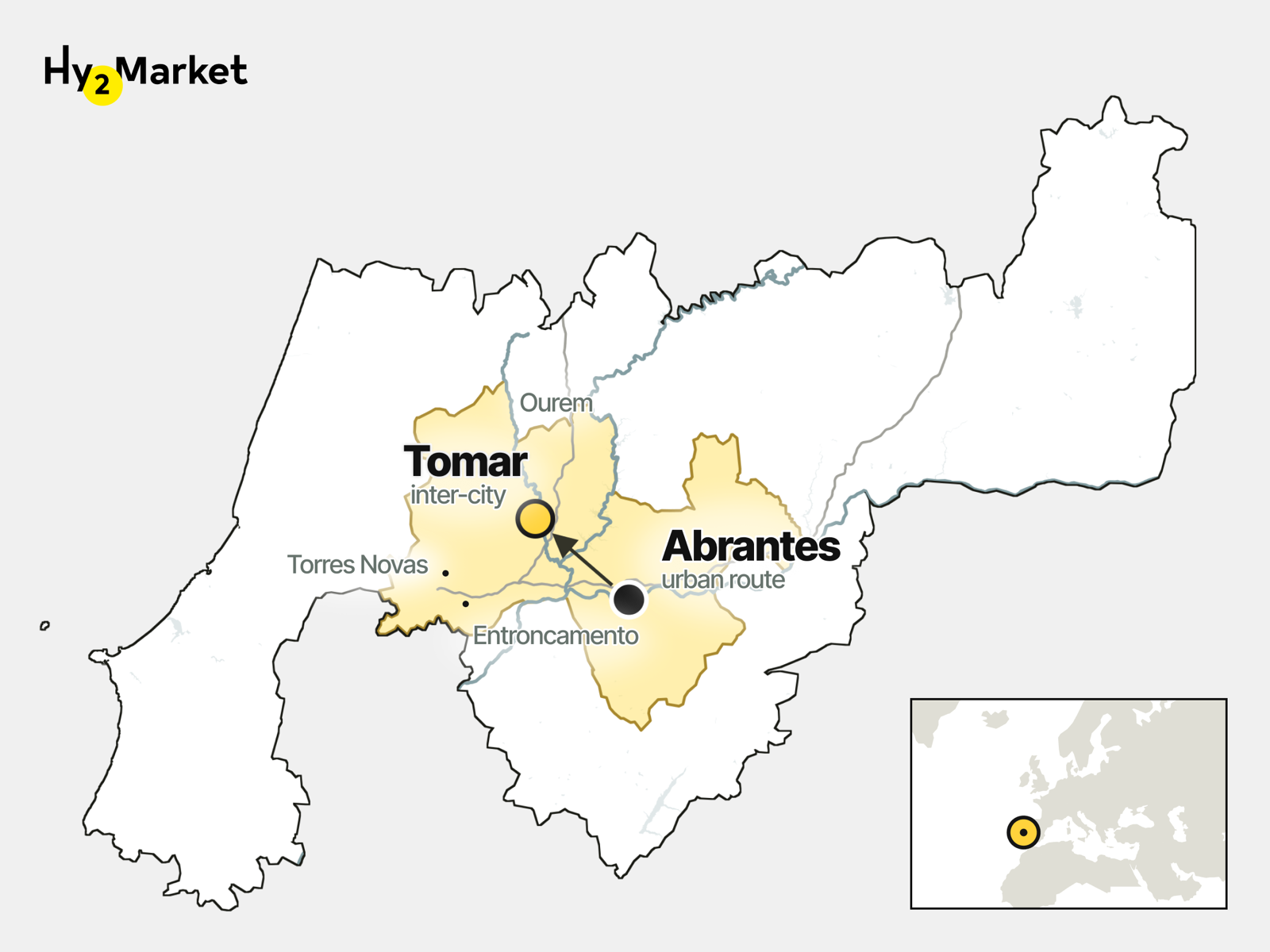
Médio Tejo sits along the Tagus River in central Portugal — a region comprising 11 municipalities, with population centres spread across a geographically dispersed and hilly territory, including towns such as Abrantes and Tomar. The distances between population centres are long and the roads climb and fall, making hydrogen fuel-cell buses a resilient solution for zero-emission public transport.
The Médio Tejo region has developed a hydrogen strategy as part of its energy transition. In 2019, the region presented the HyTagus Valley initiative, aimed at developing a regional hydrogen value chain and promoting hydrogen applications across different sectors, including transport.
The opportunity
The Médio Tejo pilot offered an opportunity to demonstrate the operational feasibility of hydrogen mobility in a real regional public transport context, testing the bus across different routes and operating conditions — long distances, hilly terrain, low population density.
Médio Tejo 21 coordinated the pilot implementation, enabling a single demonstration to test two distinct operating contexts in sequence: an urban circuit in Abrantes, followed by longer regional and inter-city routes from Tomar. The portable hydrogen refuelling station was moved between the two locations, allowing the same bus and refuelling solution to be tested in both settings without requiring permanent refuelling infrastructure from the outset.
The solutions
Three moving parts made the demonstration work. Open each to see the detail.
How it works as one system
From hydrogen supply to public service on real routes. Hover any node to highlight it, click to open the detail.
- Green hydrogen supply
- Delivered to the portable HRS
- Green hydrogen is delivered to the portable refuelling station, the input that keeps the bus in daily service across both duty cycles.
- PRF mobile refuelling station
- Relocatable · Abrantes → Tomar
- A mobile hydrogen refuelling station from PRF – Gas Solutions. Because it is relocatable, a single station served two different sites — the Municipal Shipyard in Abrantes, then the Central Bus Terminal in Tomar — with no permanent infrastructure required at either site.
- Caetano H2.City Gold
- Advanced fuel-cell technology · 64 passengers
- A 64-passenger fuel-cell bus built by CaetanoBus using advanced second-generation fuel-cell technology. Batteries, tanks and fuel cell are mounted on the roof; measured consumption averaged 5.37 kg H₂ per 100 km.
- Public route service
- ~200 km/day · 11 municipalities
- The bus ran real public routes averaging ~200 km a day, serving the region’s 11 municipalities over nine months and 32,612 km with zero technical issues.
- Urban route · Abrantes
- Nov 2023 – Apr 2024
- The first duty cycle: a dense urban circuit based in Abrantes (Nov 2023 – Apr 2024). The route covered the city’s busiest areas, the industrial zone and the hospital, as well as secondary schools. The aim was to maximize the visibility of the project, disseminating and raising awareness of H₂ mobility.
- Inter-city route · Tomar
- Apr – Jul 2024
- The second duty cycle: a longer inter-city route based in Tomar (Apr – Jul 2024). The route covered connections between urban centres in the region to test bus consumption and performance on open-road circuits across varied terrain — from flat stretches to more rugged landscapes — while allowing a wider public to experience H₂ mobility.
- Fleet expansion
- Rodoviária Tejo · 3 buses
- Building on nine fault-free months, Rodoviária do Tejo applied for national funding for a three-bus fleet — turning a successful demonstration into a long-term operational commitment.
- Demonstration project
- Operational viability · mobility sector
- A real-world demonstration proving the technical viability of hydrogen buses on Médio Tejo routes, delivering practical operational insights and training for local public transport stakeholders.
- Knowledge exchange
- WP5 · mobility regions
- As WP5 lead, Médio Tejo 21 facilitates knowledge exchange between the mobility pilot regions — Asturias, Aragon, Constanța and Médio Tejo — bringing together lessons from their distinct pilot experiences. The collaboration provides a framework to compare operational approaches, barriers and enabling conditions for hydrogen mobility, with the findings brought together in the demonstration report (D5.2).
The process
Médio Tejo presents the HyTagus Valley hydrogen initiative.
Hydrogen bus pilot launches, based in Abrantes, coordinated by Médio Tejo 21 with IrRADIARE.
Refuelling station relocates to Tomar; the bus shifts to the inter-city route.
Nine-month demonstration concludes: 32,612 km driven, zero technical issues.
Results published.
Rodoviária Tejo applied for national funding for a 3-bus fleet expansion.
Lessons learned
Demonstrating hydrogen mobility in real public transport conditions provides the operational evidence needed to guide future investment and broader deployment.
Nine months of fault-free operation and proven route performance gave Rodoviária do Tejo the confidence to apply for national funding for a permanent fleet.
The outcomes
Médio Tejo now offers the rest of the consortium a working, real-world answer to the question every rural or hilly region asks before investing: does a hydrogen bus survive daily service? Nine months of real-world evidence are now powering a permanent fleet transition and inspiring wider adoption across the public transport sector.
Knowledge exchange
Médio Tejo leads WP5 (Hydrogen Mobility) — the work package where Hy2Market’s mobility regions share what they learn from putting hydrogen vehicles into real service. Its completed nine-month bus pilot is the reference the other regions’ demonstrations build on, while barriers, standards and refuelling know-how flow back across the cluster.
ALSA is running a Toyota/CaetanoBus fuel-cell bus on real lines at 200–300 km/day over a 36-month test. Médio Tejo’s duty-cycle results and 5.37 kg H₂/100 km consumption give a fleet operator a proven benchmark for a longer-duration trial.
MEDGreen and IAC Special Projects are designing an innovative 100 kW fuel-cell minibus. Médio Tejo’s real-world operating experience helps de-risk the vehicle concept before a wheel is built.
Lessons flow back too: Constanța coordinates the regional pilots into a shared demonstration report (D5.2), while Northern Netherlands and Western Macedonia add regulatory and roll-out perspective from the barriers-and-standards work (Task 5.1).