Green hydrogen is only useful if it can travel from where it is made to where it is used. Steel pipelines are the reliable industry standard for hydrogen transport, and every material has its trade-offs — for the short, distributed and obstacle-crossing routes a regional network needs, a flexible non-metallic pipe can be a complementary option that installs quickly without welding.
One material, two deployments. The SoluForce reinforced thermoplastic pipe (RTP) is in use worldwide, with over 4,500 km installed since 2000 across oil & gas, water, mining and hydrogen. Here its non-metallic, hydrogen-certified pipe — laid from 400 m spools, joined without welding — is used as a distribution connector in Deventer (built as phase zero of an open grid with Firan) and specified for the HyEnergy TransStore hub pipeline in Delfzijl, designed to cross beneath the Oosterhornkanaal and a ProRail railway in a first-of-its-kind dual crossing.
In Deventer, a hydrogen line from production to off-taker Nefit Bosch, in the ground in roughly two months. In Delfzijl, a hub pipeline designed through detailed engineering, including a first-of-its-kind canal and rail crossing. Together they establish reinforced thermoplastic pipe as a fast, embrittlement-free building block for the Dutch hydrogen network.
Benjamin Pilzer, Senior Business Developer Hydrogen, Firan, and Peter Cloos, Technical Manager, SoluForce — on building a local hydrogen grid in Deventer.
The region
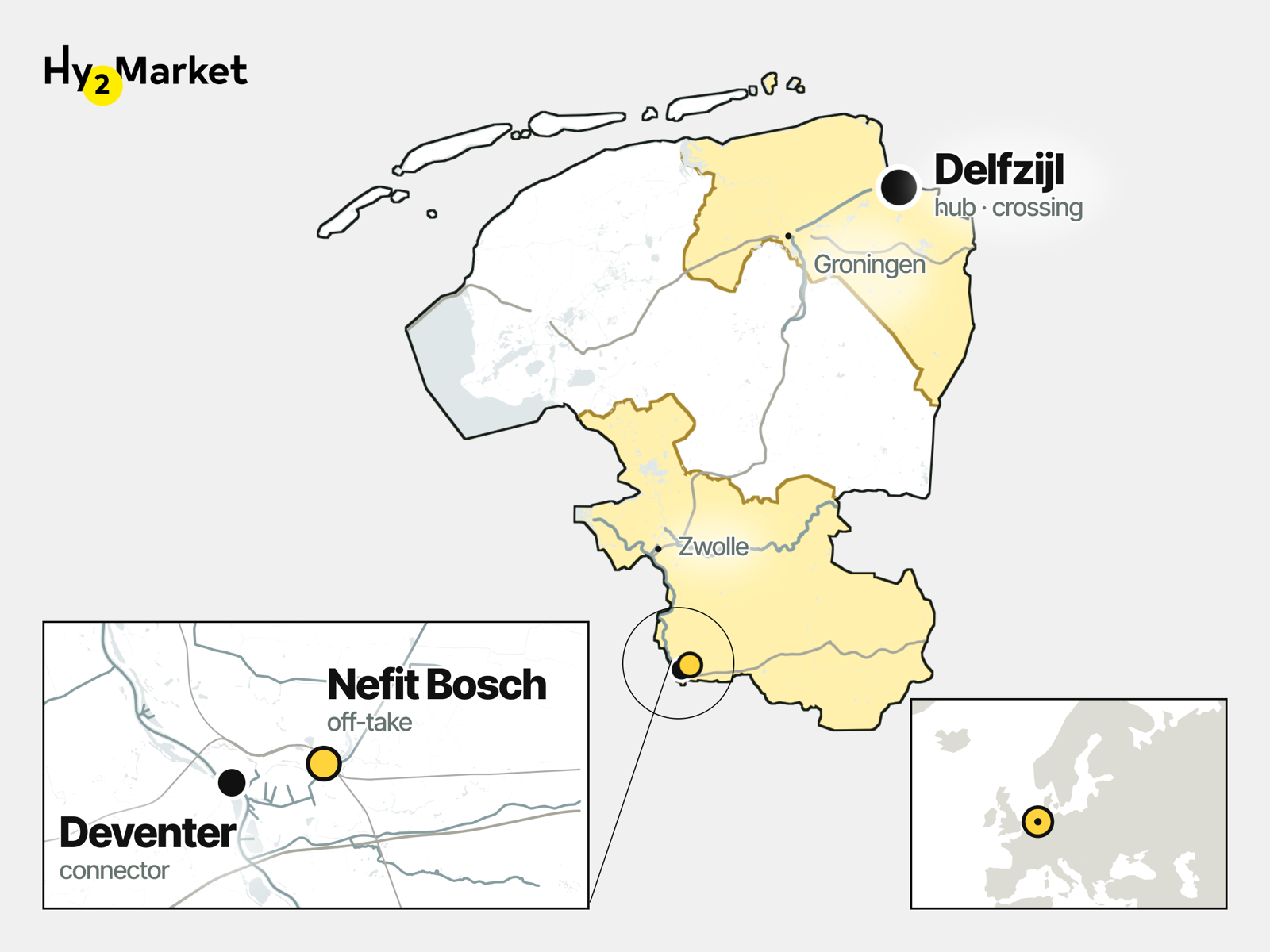
The Netherlands is one of Europe's most committed hydrogen markets, and its network operators are already moving the molecule at regional scale. In Deventer, Firan — a subsidiary of Alliander and sister of the DSO Liander — is standardising a future hydrogen distribution grid, with Nefit Bosch as the anchor off-taker and New Energy Coalition coordinating Hy2Market.
Some 200 km north-east, near Delfzijl, HyEnergy TransStore is developing a pipeline from Nobian's production site to a new distribution hub, where hydrogen is purified and compressed before it is loaded into tube trailers. The route crosses the Oosterhornkanaal and a railway managed by ProRail. Both deployments run on the same SoluForce reinforced thermoplastic pipe.
The opportunity
Green hydrogen is only useful if it can travel — and over short, awkward routes a flexible non-metallic pipe opens up a fast, weld-free option.
SoluForce's non-metallic pipe changes that calculus, and Hy2Market gave it two live proving grounds. Dutch standards written for natural gas typically limit non-metallic pipe to below 16 bar, so each project builds its own case through certification, a project-specific risk assessment and engineering calculations. In Deventer, Firan chose the connector as the first section of a local hydrogen backbone after an earlier project in Emmen could not proceed; Firan and SoluForce, originally in different work packages, came together when the consortium flagged the need for RTP demonstrators. In Delfzijl, the same pipe is the enabling technology for a hydrogen hub whose route passes beneath a canal and a ProRail railway, a crossing suited to a flexible line pulled through a bore.
The solutions
Three things make this work: a hydrogen-ready material, an installation method suited to tight and obstacle-crossing routes, and two real deployments proving it.
How it works as one system
The same SoluForce transport method — from hydrogen supply, through the flexible pipe, to the off-take — plays out in two Dutch deployments.
- Hydrogen supply
- Trailer · future electrolyser · Nobian by-product
- Hydrogen enters from tube-trailer bays and a planned 2.5 MW electrolyser in Deventer, and in Delfzijl partly from Nobian chlor-alkali by-product hydrogen — local, scalable supply points for each deployment.
- SoluForce reinforced thermoplastic pipe
- Reinforced thermoplastic · MOP 52 bar
- A fully non-metallic reinforced thermoplastic pipe certified for hydrogen to 52 bar. Hydrogen never touches metal, so there is no embrittlement risk, and the pipe is hydrogen-tight (permeation-free).
- Spool & bore-pull installation
- Weld-free · 400 m spools
- Delivered on 400 m spools and installed in long continuous runs with electrofusion joints instead of welding. Its flexibility lets a single length be pulled through a pre-made bore — the method designed for the Delfzijl canal and rail crossing.
- Off-take
- Nefit Bosch · HyPlanet trailer filling
- In Deventer the line delivers to the Nefit Bosch test facility at 9.5 bar; in Delfzijl it feeds HyPlanet's bulk hydrogen trailer-filling station at the hub.
- Deventer connector
- Firan · phase 0 · 9.5 / 16 bar
- 2 × 120 m linking a tube-trailer bay and future electrolyser to Nefit Bosch at 9.5 bar, as phase zero of a planned 16 bar open distribution grid developed by Firan.
- Delfzijl H2 hub
- HyEnergy TransStore · Green Planet
- A hydrogen hub owned by HyEnergy TransStore (hub developed by Green Planet), fed partly by Nobian by-product hydrogen. Hydrogen is purified and compressed at the hub before trailer loading, with an initial capacity target above 2,000 kg/day.
- First-of-its-kind crossing
- Under a canal AND a ProRail railway
- The Delfzijl line is designed to pass beneath the Oosterhornkanaal and a railway managed by ProRail. Each crossing needs its own drilling and installation method, a protective casing and coordination with the asset owner.
- Firan & HyEnergy TransStore
- Network operators
- Firan is a future hydrogen distribution system operator in Deventer; HyEnergy TransStore owns and operates the Delfzijl hub asset. Both design, realise and then run their networks.
- A transport blueprint
- Other Hy2Market regions
- A weld-free, low-cost, embrittlement-free way to connect a producer to an off-taker fast — even under canals and railways — a transport playbook other Hy2Market regions can copy.
The process
Firan and SoluForce enter Hy2Market in different work packages; SoluForce's flexible pipe is earmarked for live Dutch deployments.
SoluForce route and engineering studies. Deventer becomes the first section of Firan's local hydrogen backbone, and the Delfzijl pipeline scope is approved.
A 2 × 120 m connector to Nefit Bosch is permitted, financed and laid in roughly two months — phase zero of an open grid.
Detailed engineering for Delfzijl shows more demanding crossing conditions and additional manifold and metering requirements. The budget is revised.
Deventer's phase-one open grid is awaiting its final investment decision. Delfzijl is securing additional funding ahead of installation.
Delfzijl drilling, installation, connection at both ends and commissioning.
Lessons learned
The hardest lessons were organisational, not technical — and the clearest was about scope of work.
Because RTP was a new material for Firan, both partners had to keep an open mind and share knowledge in both directions — Firan learning the material's safety envelope, pressure ranges and maintenance needs; SoluForce learning Dutch contractors and permitting on its second installation in the country. Matching the infrastructure concept to the product specification and the authorities' requirements came first: in Deventer, that meant checking diameters, fittings, pressure rating and pull-in conditions against the network design. A key benefit Firan valued is the pipe's flexibility — because it bends, it suits awkward, winding routes and runs under or alongside existing cables and pipes without the standard bends and special couplings a rigid line would need. In Delfzijl, the crossing, casing, drilling and connections form one interdependent scope that drives design, approvals, cost and schedule together — which makes the same lesson sharper: define, in detail, who is responsible for what before you build.
The outcomes
Across two deployments, the Dutch pilots demonstrate how a proven solution can be effectively deployed in new applications and environments. SoluForce's reinforced thermoplastic pipe let Firan lay a distribution connector in Deventer in weeks, and gives HyEnergy TransStore a route for its hub pipeline beneath a canal and a national railway in Delfzijl. Together they show how regional hydrogen transport can be connected quickly and flexibly, and hand the consortium a replicable playbook for connecting producers to off-takers.
Knowledge exchange
What the partners exchanged with each other across the two Dutch deployments.
Firan and HyEnergy TransStore learned the pipe's safety, pressure and installation envelope; SoluForce learned Dutch permitting, contractors and infrastructure-crossing practice.
The same pipe specification informs SoluForce's route studies for Vensolair's island-to-shore line beneath the Rhône and for the Asturias route.