Peaker turbines keep the lights on when demand spikes: Terna, the operator of Italy’s electricity grid, calls the Giammoro turbine into operation for one to two hours a day. It burns natural gas. Green hydrogen could lower those emissions, but it costs several times more than hydrogen made from natural gas, and transporting it adds to the bill.
A complete hydrogen chain on one site. A 1 MW alkaline electrolyser runs on renewable electricity supplied by Duferco Energia (documented through Guarantees of Origin); the hydrogen is compressed, stored at 200 bar and blended into the turbine’s natural gas at up to 15% by volume. CNR-ITAE coordinated the pilot with Duferco, De Nora, Power Evolution and Snam, with modelling support from Summit Engineering and DEMCON, under the EU’s I3 (Interregional Innovation Investments) Instrument.
Within Hy2Market the partners designed, built and integrated a complete green hydrogen plant beside a working peaker turbine. Modelling carried out in the project indicates that a 15% hydrogen blend can cut carbon monoxide emissions by nearly 30% and CO₂ emissions by around 9% while keeping turbine operation stable, with nitrogen oxide levels expected to hold steady. Results from on-site testing are expected in 2027.
Francesco Sergi, Lead Researcher, CNR-ITAE — on why the Sicily pilot produces hydrogen next to a grid-balancing turbine, and what the modelling predicts.
The region
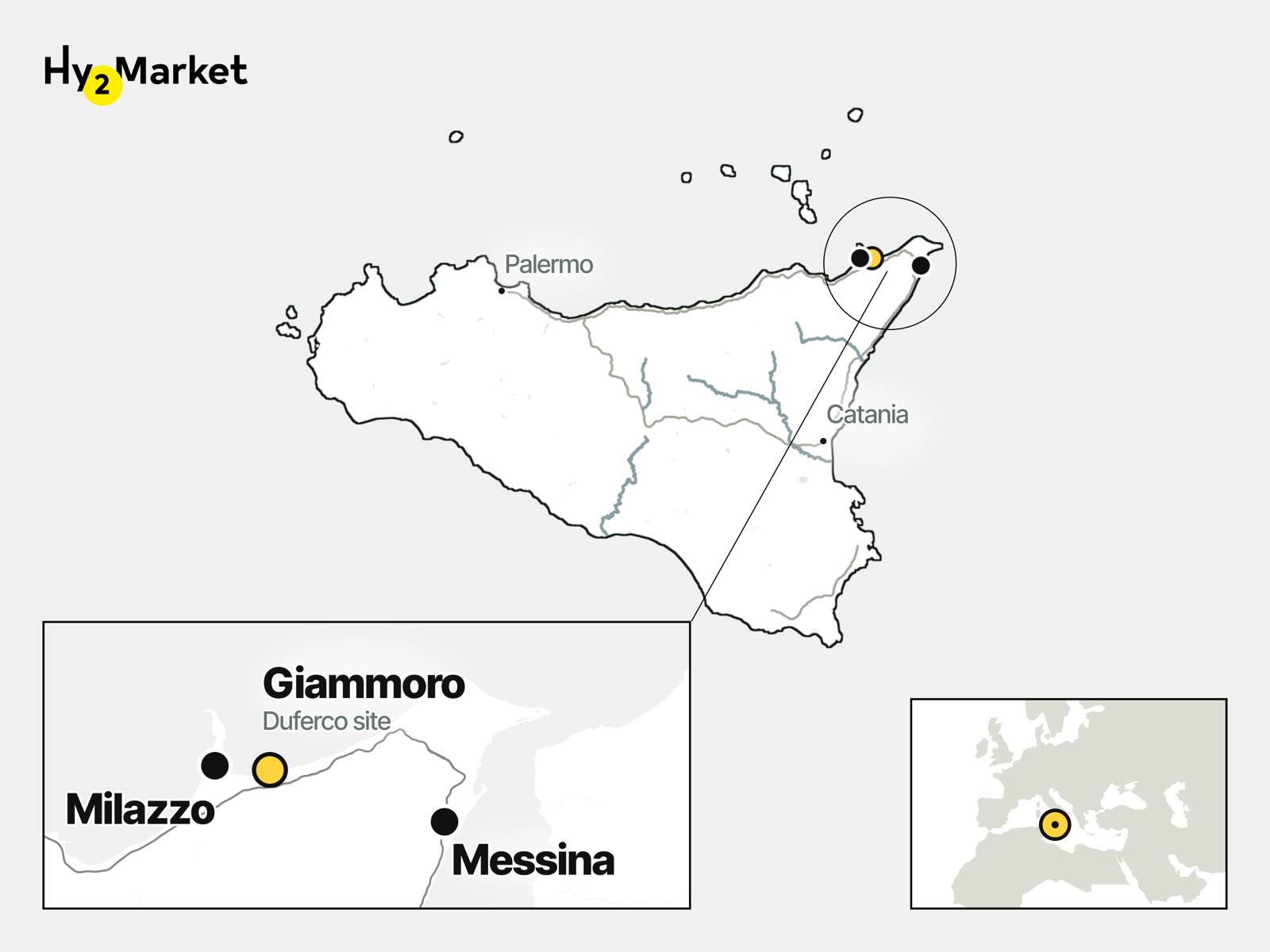
Giammoro sits on Sicily’s north-east coast, between Milazzo and Messina, on a former steelworks that Duferco is reconverting into an energy and logistics hub. Sicily has some of Italy’s strongest sun and wind, and the island’s south now leads the country in requests to connect new renewable capacity — but as a grid at the edge of the national network, Sicily leans on local plants that can be switched on to keep supply and demand in balance.
Duferco’s gas-fired peaker turbine at Giammoro is one of them: Terna, the operator of Italy’s electricity grid, calls it into operation to steady the Sicilian system. The hydrogen plant is the first in the region to blend green hydrogen into a peaker turbine’s fuel — and part of a wider reconversion of the site, alongside solar, battery storage and a new container terminal, that turns the old steelworks towards clean energy.
The opportunity
The pilot was set up to show that green hydrogen can decarbonise peak-time electricity when it is produced and used on the same site — and that an existing gas turbine can take a hydrogen blend without losing stable operation.
Green hydrogen currently costs around €7–9 per kilogram, against roughly €1.50–2 for hydrogen made from natural gas. In Giammoro the hydrogen is not a product to sell: it is produced and consumed on the same site, which takes transport out of the equation and improves the economics. The test programme prepared in the project covers the whole chain — electrolyser, integrated plant and turbine — measuring CO₂ and nitrogen oxide emissions and any change in turbine efficiency on the blend.
The solutions
Three pieces of hardware and one model turn renewable electricity into lower-carbon peak power. Open each to see the detail.
How it works as one system
How green hydrogen made on site joins the gas supply of a 58 MW peaker turbine. Hover any node to highlight it, click to open the detail.
- Electrolyser
- 1 MW · ~20 kg/h
- Makes green hydrogen from renewable electricity and demineralised water.
- Hydrogen compressor
- 200 bar
- Raises the hydrogen to storage pressure.
- Hydrogen storage
- ~1 hour at full load
- Banks hydrogen between demand peaks, so the electrolyser can run steadily while the turbine runs briefly.
- Blending point
- up to 15% by volume
- Hydrogen joins the natural gas after the metering cabinet — up to about 200 kg an hour at full load.
- Fuel compressor
- 58 bar
- Brings the blended fuel up to the turbine’s inlet pressure.
- Peaker turbine
- 58 MW
- Burns the blend and sends electricity to the grid when Terna calls it into operation.
- Renewable electricity & water
- Duferco Energia + on-site well
- Duferco Energia supplies the electricity through the industrial site’s network — 100% renewable for the test campaign, documented through Guarantees of Origin; an on-site well supplies the water.
- Snam gas network
- 14–24 bar
- Natural gas arrives from Snam’s network through a fiscal metering cabinet and remains at least 85% of the fuel.
- Stack
- emissions measured
- Testing measures CO₂, carbon monoxide and nitrogen oxides in the exhaust.
The process
Design and modelling of the full hydrogen chain, including the Fire Brigade permit application and submission of the Integrated Environmental Authorization (AIA).
Construction works begin at Giammoro: foundations, underground piping, platforms for the equipment and the pipe rack to the turbine.
The electrolyser — factory-tested by De Nora in Milan — is installed, together with the compression system and the hydrogen storage tanks.
Installation is completed, including pressure testing and PED (Pressure Equipment Directive) certification.
Commissioning and the on-site testing campaign begin.
Test results expected: hydrogen production first, then the turbine on a hydrogen blend.
Lessons learned
Before the plant has even run, the lessons are about getting there: model before you build, and start permitting early.
- Permitting sets the pace — Italy’s integrated environmental authorisation became the critical path: the plant could be built without it but not switched on, and the review ran through rounds of technical questions and meetings with the authorities.
- Integration reaches every system — bringing hydrogen into an existing industrial site meant coordinating fire protection, fire and gas detection, shutdown logic and medium-voltage electrical infrastructure, alongside the interfaces between production, storage and the turbine.
- “Hydrogen-ready” is a starting point — even a turbine rated hydrogen-ready needed some retrofit and a re-tuned control system to take a 15% blend.
- Model before investing — modelling gave an early answer on emissions, pointing to no increase in nitrogen oxides, and tested the system under different electricity prices and renewable supply before the plant was built.
- Make it where you use it — producing hydrogen on the site that consumes it avoids transport and gives green hydrogen a more realistic business case than buying it in.
- A step up in scale — for the Sicilian supply chain, the pilot meant moving from laboratory-scale systems to designing, installing and operating an industrial-scale hydrogen plant.
The outcomes
These are modelled, not measured, figures — the on-site testing campaign begins in 2027 and will replace them. The Sicily pilot’s result within Hy2Market is the plant itself: a full hydrogen chain designed, built and integrated next to a working power turbine, taking the integrated plant from TRL 6 to TRL 7 — a system prototype demonstrated in a real operational environment. The modelling points to meaningful emission cuts at a 15% blend without destabilising the turbine, and testing will show how closely the plant matches the model.
Knowledge exchange
Sicily’s pilot was shaped with partners in other Hy2Market regions. Its hydrogen value chain was modelled together with engineering partners in the Netherlands, and the approach is built to travel: change the electricity market, the renewable resource and the industrial use, and it can test the feasibility of a hydrogen project elsewhere in Europe.
Summit Engineering in Groningen modelled the Sicily plant alongside CNR-ITAE and DEMCON, with weekly working sessions to compare results. Running more than one model on the same plant let the partners check one another’s findings before the investment was made.
CNR-ITAE developed Hy2L within Hy2Market: a decision-support tool for designing and assessing green-hydrogen plants. From hourly energy prices, renewable profiles and hydrogen demand, it sizes the plant’s components and optimises their hour-by-hour operation for the lowest levelised cost of hydrogen (LCOH) — drawing on the project’s industrial cases, Sicily among them.