Western Macedonia is moving away from decades of lignite dependence, but still lacks a mature hydrogen value chain and the heavy industry — steel, cement, refineries — that would drive demand. Greece's national hydrogen policy is still taking shape, leaving room for the region to find its own path.
CluBE is using Hy2Market to build the region's readiness rather than infrastructure: mapping training needs, feeding regional data into Europe-wide roll-out planning, contributing to EU standards work, and building ties with more advanced hydrogen regions through study visits — all feeding into Western Macedonia's own energy-transition plans.
Western Macedonia entered the project without a mature hydrogen infrastructure. It now has a ready-to-use training framework, a seat in Europe's standards conversation, and real momentum behind LIFE GREENH2ORN, North-1 and a hydrogen-ready pipeline.
The region
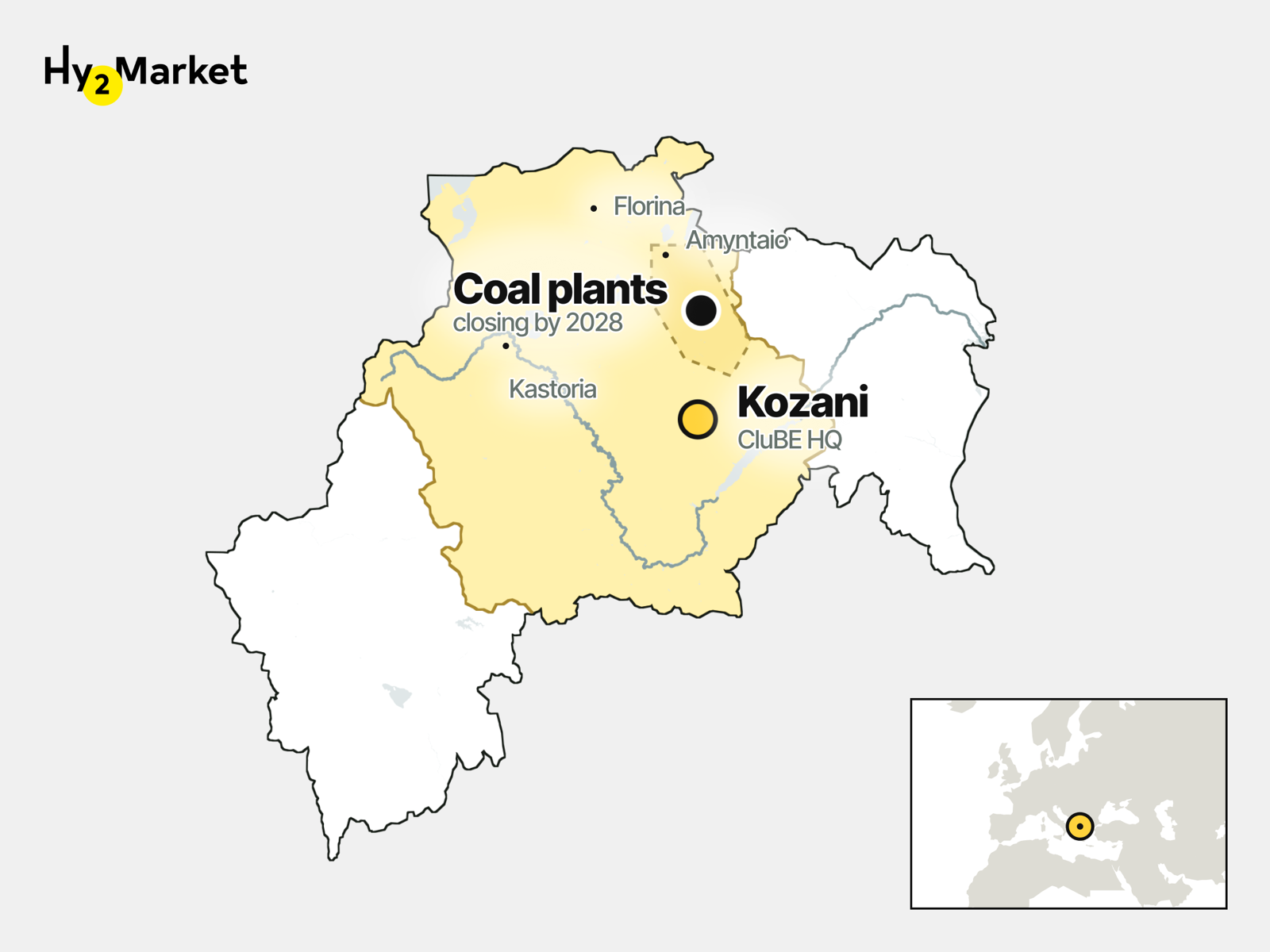
Western Macedonia generated over 75% of Greece's electricity from lignite — until now. Its coal plants close by 2028, leaving a gap in jobs and skills that CluBE, a Kozani-based non-profit cluster, was set up to fill by steering the region toward bioeconomy and green hydrogen.
It brings real assets to that shift — abundant solar and wind, and a seat on one of Europe's prospective hydrogen export corridors from Greece into Western Europe. CluBE is Greece's only Hy2Market partner, linking local stakeholders to the wider European network.
Knowledge exchange
Hy2Market's biggest value for Western Macedonia has been connecting CluBE with people and regions already deploying hydrogen — new partnerships and real lessons learned.
An informal exchange comparing hydrogen mobility pilots in Greece and Portugal — CluBE is studying Médio Tejo's hydrogen bus experience for lessons it can apply once its own refuelling station opens.
CluBE is talking with Dutch and Austrian partners about turning sewage sludge and other residual streams into renewable hydrogen. It feeds a CluBE priority: a future biorefinery in Western Macedonia for resource recovery and hydrogen production.
How CluBE contributed
Three work strands where CluBE fed regional expertise into Hy2Market's consortium-wide efforts. Open each for detail.
- 1st Hydrogen Summer ScH2ool: 78 participants
- 2nd Hydrogen Summer ScH2ool: 63 participants
- 3rd Hydrogen Summer ScH2ool: 46 participants
- 4th Hydrogen Summer ScH2ool: 78 participants
- Total: 371 participants across six training programmes
More at greenskillsforhydrogen.eu.
The regional hydrogen landscape
A hydrogen refuelling station, a 50 MW electrolyser and a hydrogen-ready pipeline — the real momentum in Western Macedonia that Hy2Market's work is preparing the region to meet.
* Not a Hy2Market deliverable — regional momentum shown for context.
- LIFE GREENH2ORN
- LIFE-funded · Municipality of Kozani
- A LIFE-funded hydrogen refuelling station in Kozani — Greece's first with on-site green hydrogen production. Led by the Municipality of Kozani with partners including DEPA Commercial, European Dynamics, the University of Western Macedonia, DIADYMA, CluBE, Acea Infrastructure and B&T Composites. Serves municipal and partner fleets. September 2024–August 2029.
- North-1
- Hellenic Hydrogen
- A 50 MW electrolyser project led by Hellenic Hydrogen, funded by the EU's Just Transition Fund. Sited in Amyntaio, Western Macedonia, with approval expected soon and a target to complete by end of 2027. Capacity is expandable to 200 MW.
- High-Pressure Natural Gas Pipeline to Western Macedonia
- Existing infrastructure
- An existing pipeline already built to carry up to 100% hydrogen. Plans call for injecting North-1's green hydrogen once both projects are running — a few years out. 157 km, operated by DESFA, the Hellenic Gas Transmission System Operator.
- DEPA Commercial's Green Hydrogen Strategy
- Optional · outside Hy2Market's scope
- CluBE has advised DEPA Commercial S.M.S.A. — Greece's national gas supplier and future owner of the LIFE GREENH2ORN refuelling station — on its green hydrogen strategy, helping bring European policy, regulation and market insight into the company's strategic planning.
Lessons learned
The clearest lesson CluBE takes from Hy2Market: interregional collaboration is essential. It lets emerging regions like Western Macedonia learn from more mature ones through real knowledge exchange and proven approaches.
- Renewables are abundant and growing fast here, but without national hydrogen investment, the region can't yet follow the mature regions it studies.
- With no local industrial offtake, unlike Upper Austria or Sicily, mobility — and longer-term, export along a Greece-to-Germany corridor — are the region's most realistic paths.
- Training isn't one-size-fits-all — a safety officer and a project manager need entirely different curricula, which shaped how CluBE built its training guidelines.
The outcomes
The bigger win here is relational: a network of contacts across Europe's more mature hydrogen regions, built through study visits and knowledge exchange, that CluBE can keep drawing on as its own hydrogen plans develop.